As the data becomes pervasive in today’s digital organization, it is imperative to think of managing data as a corporate discipline; just like managing capital in an organization carved out the corporate finance discipline in virtually all of today’s modern day organizations.
As data (as asset) is more democratized than probably any other corporate asset, governance becomes a key function in ensuring an effective leverage of data.
Governing the enterprise data begs a rethinking from ground up. This article borrows some key concepts from an organizational design and management and applies it to data governance. It suggests a three pronged approach towards establishing a data governance practice or a chief data office.
As a typical organization scales up in complexity, establishing the right accountability, control and performance structures become critical for its success. Similarly, as complexities build up in enterprise data, having the right structures for its accountability, control and performance become essential.
Below described are a few key elements within each of the three aspects of a data office or data governance organization:
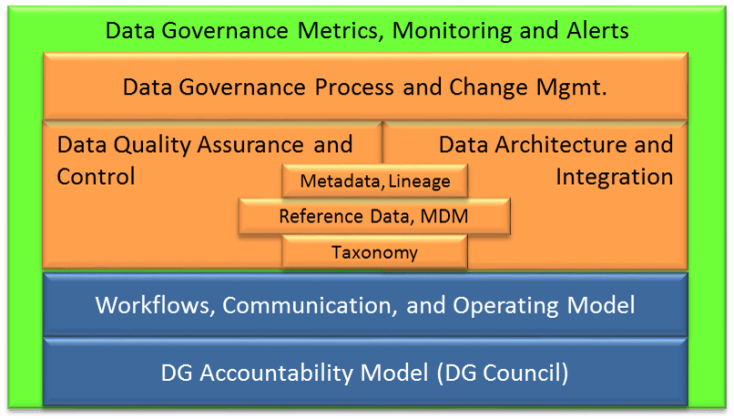
Accountability: Every individual, process or an application that touches the data (from a generation, manipulation or consumption standpoint) needs to hold accountability towards the data asset or data flows. Typically, accountability starts with establishing the appropriate roles, responsibilities, factoring in communication, workflows and escalation pathways. Individual accountability towards data should be baked into the job description.
Control: Being accountable without adequate levers and controls is to set up the data organization for a failure. Control framework includes means to standardize data, quality assurance and control the data, any required tools, standard procedures/processes, templates and technology platforms that gives the teeth to the accountability assigned. Also included in control should be the incentives for people to perform these additional responsibilities.
Performance: Finally, having accountability and control mechanisms in place do not guarantee outcomes, which is improving the digital maturity, without the virtuous feedback loop of performance measurement. Through KPIs and metrics around how effectively the data is being governed, a holistic performance management framework should address the need for a sound way to measure and improve governance.
With the above three aspects, a data office can confidently set out to improve the larger organization’s digital maturity.
Below is an indicative Data Governance Framework
 My C World
Leave a comment