Search

My C World

A Learning Site

Category

Digital

Governing Enterprise Data – The three key ingredients

As the data becomes pervasive in today’s digital organization, it is imperative to think of managing data as a corporate discipline; just like managing capital in an organization carved out the corporate finance discipline in virtually all of today’s modern day organizations.

As data (as asset) is more democratized than probably any other corporate asset, governance becomes a key function in ensuring an effective leverage of data.

Governing the enterprise data begs a rethinking from ground up. This article borrows some key concepts from an organizational design and management and applies it to data governance. It suggests a three pronged approach towards establishing a data governance practice or a chief data office.

As a typical organization scales up in complexity, establishing the right accountability, control and performance structures become critical for its success. Similarly, as complexities build up in enterprise data, having the right structures for its accountability, control and performance become essential.

Below described are a few key elements within each of the three aspects of a data office or data governance organization:

Accountability: Every individual, process or an application that touches the data (from a generation, manipulation or consumption standpoint) needs to hold accountability towards the data asset or data flows. Typically, accountability starts with establishing the appropriate roles, responsibilities, factoring in communication, workflows and escalation pathways. Individual accountability towards data should be baked into the job description.

Control: Being accountable without adequate levers and controls is to set up the data organization for a failure. Control framework includes means to standardize data, quality assurance and control the data, any required tools, standard procedures/processes, templates and technology platforms that gives the teeth to the accountability assigned. Also included in control should be the incentives for people to perform these additional responsibilities.

Performance: Finally, having accountability and control mechanisms in place do not guarantee outcomes, which is improving the digital maturity, without the virtuous feedback loop of performance measurement. Through KPIs and metrics around how effectively the data is being governed, a holistic performance management framework should address the need for a sound way to measure and improve governance.

With the above three aspects, a data office can confidently set out to improve the larger organization’s digital maturity.

Below is an indicative Data Governance Framework
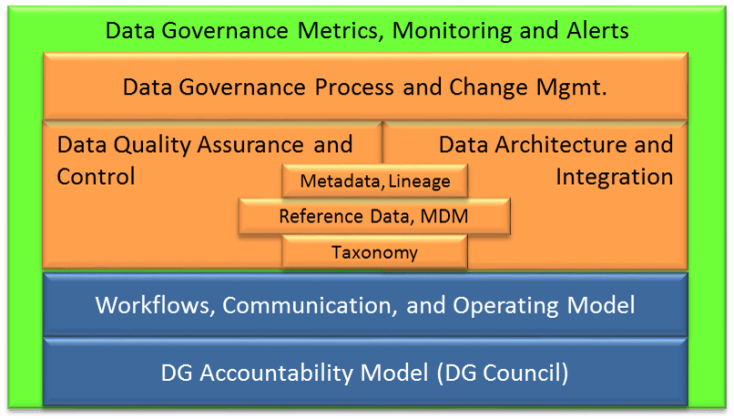
Data Governance Framework v1.0

Data behind your Actions – Part I – The Realization

Data is behind all of your actions. You realize it or not. Most of our day to day actions happen in an autopilot mode as our brain establishes freeways on most frequently taken action pathways to results. For example, sitting, brushing, saying “Hello” to anyone you bump into all happen so commonly that without our deeper attention they just happen.

A group of these pathways and routines are baked into models. A model is a template or a good approximation of how things work in the real world. For example, a typical work day morning can be modeled as, One gets up, starts the coffee machine, brushes, prepares breakfast and you can fill in the rest…

A model gives your brain an easy map of how to navigate and maneuver the world. You encounter a strange situation, your brain searches takes a ‘seemingly alike’ model(s) and starts amending them to have a variation in your maps, just in case you come across the situation again.

I would like to focus this story around how a group of people (call them organizations) act and the models the group uses. Take for example, Managers. Have you ever wondered how do Managers act? Part it is based on the models they build for themselves. Not all managers respond in exactly the same way. You see their maps are different depending on their prior experience, their latent personality and their perspective of the situation. Throw a new problem at the manager, their models get quickly adjusted accordingly.

Today’s organizations need to be fairly dynamic. They made need to scale up or scale down actions at a short notice, change their responses totally or embrace new ways of acting. For example, a new competitor may surprise you by introducing a similar product a month before the launch of yours. What is your response? The managers may not have a model for that, but they figure a response quickly and may amend their models for this eventuality in the future.
Most day to day problems that a manager encounters, they build these established model maps. They pass on pieces of these maps to their teams. What to do when your shipment is delayed, how to respond to your delayed receivables.

So, here is the challenge: Is there a framework to help us streamline our actions so that we act as a group in a predictable and effective way? If we don’t have a framework, it is fairly easy to build one for ourselves. The following four steps hold promise: Understand, Analyze, Asset-ize and Leverage

Understand: The first step is to understand the decision making model. Start with the most common types of problems you encounter and the way you arrive at possible solutions, think of it as a recipe to solve those problems.

Analyze: Second analyze the external tools you use to solve the problems. Focus on the data related tools. It could be some reports, google, daily news or even word of mouth from your peers. At what stage you use these tools and how much of weightage you give to the data and how important they are. Will these data be useful to others and if yes, how do they get it currently.

Asset-ize: If anything data is used repeatedly, it qualifies to be elevated to an asset. The more assets you have per action pathway, the easier it will be to control scaling up, scaling down of activities and adapting to change. Overall communication overhead will go down.

Leverage: Finally, you follow a methodical approach to leverage the assets. The next part of this series builds on this.


What is Digital

In my previous article, I referred to Digital Transformation as the enterprise world catching up with the consumer world from a sophistication stand point. In a nut shell, it is how you take advantage of the technologies consumer world has to realign and transform enterprises to gain competitive advantage.

In this article, I would like to elaborate and define some characteristics of what Digital means for today’s enterprises. In my view, this McKinsey article, captures the highlights. Digital defines a broad range of technologies and applications that enable:

  1. More efficient automation,
  2. Better decision making,
  3. Stronger connectivity with customers and other external stakeholders, and
  4. More advanced data-driven innovations.

These technologies, together with business process redesign, make possible a new way of working that can fundamentally transform an enterprise. It is worth noting that all of the above four points are interlinked. For instance, data driven innovations could result in the remaining three.


Demystifying Digital Transformation

Everyone is talking about Digital. But, what exactly is it?

To put it simple, it is the competition between consumer and enterprise technologies.

The invention of a microprocessor changed it all in 80s. The mere possibility of performing certain critical but repeatable tasks at an unthinkable pace changed it all (e.g., accounting and book keeping). The idea raised the curtain for Information Technology age. But, this did not change much for the business consumers. Businesses became more predictable i.e., business habits were streamlined (e.g., the way you plan for a production batch). Standardization at the cost of responsiveness. Customers did not have much choice too (read customization) as they were technologically less mature than the companies.

Back in early 2000s, with the possibility of internet, a some power was put in the hands of consumers this time. Some businesses such as Amazon took this opportunity and started playing an intermediary between many small scale producers and the consumers. Consumers treated these companies from a convenience, affordability and responsiveness standpoint.

2007 changed it all again. When the first smart phone was released little did people realize it was going to change the very way we interact again.Less than seven years later, Consumer technology was out competing the enterprise technology.

Enterprise technologies are losing in the competition with technologies in the hands of consumers. Consumer expectations are increasing at a pace faster than they could be satisfied. Many of us are frustrated with simple things such as, I can’t find the customer service number for my Telco on their website, huh! Thank god I can google it.

Those companies that can talk to people in the new age tech language are gaining ground. For them missing is the enterprise “sunk investment” baggage. They got the advantage of NOT dealing with organizational inertia (changing organizational habits) and get to simplify business processes to reach to the consumer fast. Lastly, scale comes cheaply now.

All these are pushing the large and old businesses that are operating at a scale to compete with the new startups.Therefore, most businesses want to undergo the digital transformation themselves. They must either match up with the consumer technologies or out compete with them. This to me is coined as Digital transformation.


Create a free website or blog at WordPress.com.

Up ↑